
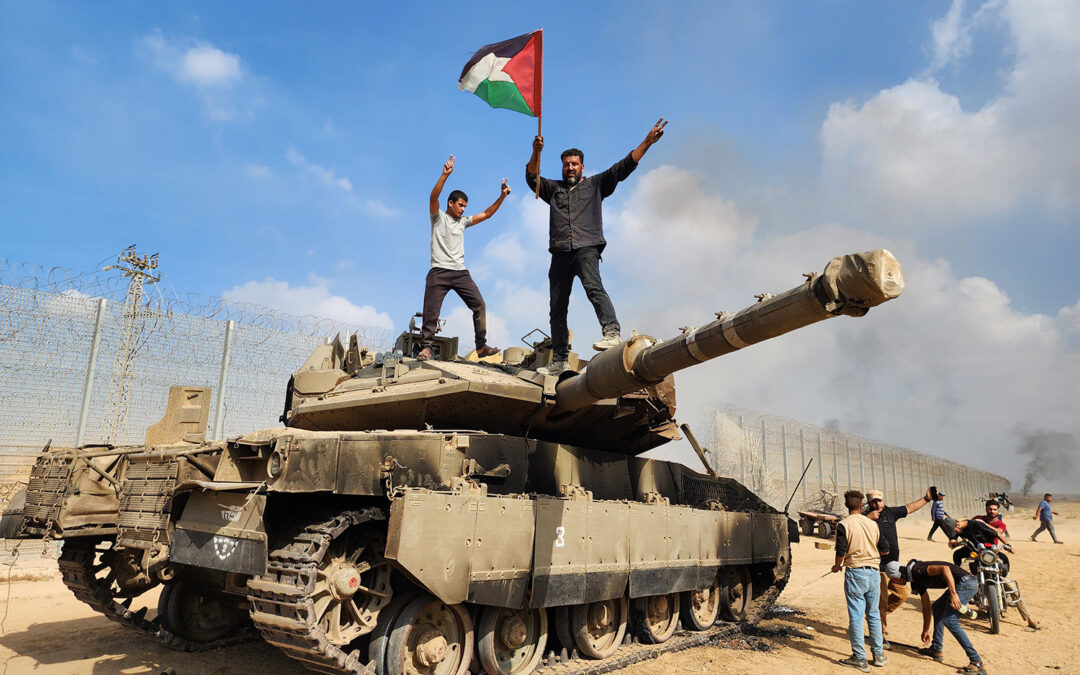
The following article was published in Arabic at Al-Masirah and Palestine Today:
The Palestinian Resistance: Heroism on the Battlefield and the Urgent Need for a Political Project
By Khaled Barakat
 The Palestinian resistance has demonstrated, throughout the ongoing genocide, the highest capacity for steadfastness and initiative. It has succeeded in entrenching its presence as the leading actor confronting the Zionist settler-colonial project. However, important as this reality is, it does not negate a fundamental crisis afflicting the Palestinian national movement as a whole, and at its core, the armed resistance in particular: the absence of a liberatory political project, and the absence of a national front capable of transforming resistance action into a comprehensive political and social path of liberation. No liberation movement confronting a settler-colonial project can triumph through military heroism alone, regardless of the scale of its sacrifices, unless that heroism is underpinned by a clear intellectual and political vision, and by a national strategy shaped with the participation of the people: one that defines the objective, manages the conflict, and prevents the circumvention or neutralization of achievements.
The Absence of a Unified National Front After the Death of the Palestine Liberation Organization
At the moment of its founding, the Palestine Liberation Organization was not merely a formal representative framework; it was a national front that brought together diverse social classes and revolutionary forces in confrontation with Zionist colonialism. However, this role effectively ended in 1974 with the adoption of the slogan of the “state” instead of liberation, and then came to a practical end with the Oslo process in 1993, through which the PLO was stripped of its liberatory content and transformed into a hollowed-out body devoid of will, subordinated to the authority system and its security commitments.
Today, the PLO no longer constitutes a national front; rather, it has been reduced to a “rubber stamp” and a political façade used to provide a formal cover for forces of security coordination and to legitimize a political path completely severed from the interests of the Palestinian people and their aspirations for liberation. This political death of the organization has created a dangerous national vacuum, manifested in the absence of a national front capable of managing the struggle as an existential conflict.
In the shadow of this vacuum, resistance forces operate without a unifying national framework, rendering their actions, despite their valor, vulnerable to fragmentation and attrition, and preventing the transformation of battlefield achievements into an accumulated liberatory political capital. This is the lesson of history over a century of struggle: the crisis has never been the Palestinian people’s willingness to give and sacrifice, but rather a political leadership that, after every revolution and uprising, led them into agreements and illusions, into tighter sieges and shrinking land.
The Confusion of Resistance Forces Before the Illusion of “Reconciliation” and “National Unity”
Key resistance forces exhibit clear political confusion in their approach to the so-called “national unity,” conflating unity based on a clear revolutionary liberation program with partnership with the forces of authority and security coordination. This confusion produces no unity; rather, it creates a political illusion that shackles the resistance instead of strengthening it, and serves the interests of defeated forces and social classes that sold Palestine in exchange for securing their class privileges.
Seeking unity with forces whose functional role in “controlling the Palestinian street” and protecting the security of the occupation has been proven by facts cannot be a gateway to liberation. Instead, it reflects the absence of political clarity among certain resistance forces regarding the nature of the current phase, the principal enemy, and the boundaries of contradiction.
This confusion has led to a de facto acceptance of equations that keep the resistance on the defensive politically, granting forces that have lost their national legitimacy the ability to blackmail it in the name of “legitimacy” and “national reconciliation,” while these concepts are emptied of their true liberatory content.
Vulnerability to Regional Alliances and Their Limits
The crisis of the resistance’s political project cannot be separated from its relationship with regional alliances, particularly with Qatar, Turkey, and Egypt. These relationships, despite providing certain margins of “support” or space to maneuver and operate, impose clear political constraints in return, and push the resistance to take into account the calculations of regimes that do not view Palestine from the perspective of liberation, but from the perspective of managing the conflict.
Excessive dependence on these alliances, or treating them as a substitute for Arab, Islamic, and international popular depth, undermines the political independence of the resistance’s decision-making, limits its ability to formulate a radical liberatory discourse, and contradicts the nature of the open struggle against the Zionist project.
The aforementioned states, regardless of their differing roles, remain allies of Washington and share an interest in containing the resistance rather than unleashing its full potential, in control rather than liberation. Any political project that ignores this reality will remain incomplete and vulnerable to neutralization and hollowing-out.
The Illusion of “Arab Support” and the Role of Oil in Sabotaging the Palestinian Revolution
The Palestinian historical experience demonstrates that what was long referred to as “official Arab support” was, in essence, nothing more than a formula for sabotaging the Palestinian revolution and corrupting its leadership and political structure. This “support” was used as a tool of control and containment, binding the Palestinian national decision to the calculations of regimes rather than to the interests of liberation.
Oil money was not innocent support; it was a means of reengineering leadership, encouraging bureaucracy, weakening the popular and militant character of the struggle, and transforming the revolution into a body dependent on external funding and subject to its conditions and political ceilings. Thus, Palestinian discourse shifted from “revolution” to “state” to “authority,” culminating in nothingness.
As this “support” receded, the task was transferred to so-called European “donor states,” and to direct and indirect U.S. “support,” through a functional European-American division of labor that tied funding to political, security, and legal conditions aimed at stripping the Palestinian cause of its liberatory character and transforming it into a depoliticized “humanitarian-security file.”
Within this context, national institutions were fragmented, and near-total control was exerted by what are known as “non-governmental organizations,” which played a central role in dismantling the unified national structure and replacing political struggle for national rights with a “rights-based” and “civil” discourse detached from the essence of the cause.
In parallel, Palestinians in the diaspora were subjected to a systematic process of dispossessing them of their historical role in the national project. Their weapons were domesticated, their trade-union and popular organizations destroyed, and transformed into hollow structures or frameworks subordinated to the conditions of host states. Today, this process is carried out openly, through attempts to prevent Palestinians in exile from participating in any process of change or reconstruction of the liberation project. They are meant to become mere “communities” devoid of political role, despite the fact that the diaspora has always been, and remains, the backbone of any Palestinian liberation project.
Conclusion
The Palestinian resistance must, without hesitation, present its comprehensive national political project to the Palestinian people, as an entitlement imposed by the sacrifices and transformations produced by the Al-Aqsa Flood. It is not required to return once again to what was called “Palestinian reconciliation,” after experience has proven that this path was nothing but a mechanism for reproducing a system of failure and security coordination. What has occurred since 7 October has nullified what came before it and opened a new phase that cannot be managed with old tools.
Today, we stand before a new revolutionary legitimacy, supported by broad popular legitimacy and a genuine Palestinian majority that has seen the resistance as the representative of its will and dignity, in contrast to forces that abandoned Gaza, its people, and its valiant resistance. The gravest danger facing the resistance is to remain a spectator as these deadly mines are planted in full view, and as a conspiracy unfolds aimed at emptying the achievements of the Al-Aqsa Flood at the hands of Washington, Tel Aviv, normalization regimes, and those who have lost their conscience and their national legitimacy.