
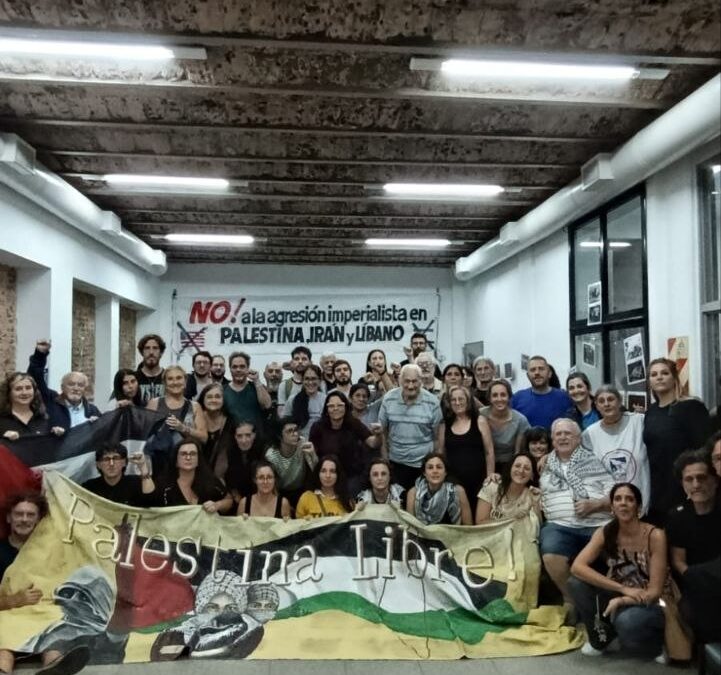
Every year on April 17, we commemorate Palestinian Prisoners’ Day, the international day of action and struggle for the liberation of Palestinian prisoners. Since 1974, this day has been observed to demand the release of imprisoned Palestinians and to pay tribute to their leading role in the resistance and revolutionary struggle for the liberation of Palestine, from the river to the sea.
This year, April 17, 2026, holds particular urgency and importance for global mobilization, as Palestinian prisoners face the most extreme forms of torture and isolation within Zionist prisons, as well as the new “Prisoners’ Execution Law” enacted by the openly fascist government of Netanyahu, Ben Gvir, and Smotrich of the Zionist regime.
Currently, there are more than 9,600 Palestinian prisoners in Zionist jails, including 350 children, 86 women, and more than 3,500 subjected to “administrative detention”—that is, imprisoned without charge or trial, under a regime that is indefinitely renewable. There are at least 1,250 Palestinians kidnapped in Gaza and imprisoned by the occupation, and more than 21 Lebanese kidnapped in Lebanon and held in occupation prisons. At least 89 Palestinian prisoners martyred in occupation prisons since October 7, 2023, since the Al-Aqsa Flood and the intensification of the Zionist genocide in Palestine, have been identified among the 326 martyrs of the Palestinian prisoners’ movement since 1967. The occupation continues to retain the bodies of the martyrs after their deaths. Israel continues to hold the bodies of more than 766 martyrs, including 97 from the Palestinian prisoners’ movement.
In this context, in the city of Rosario, Argentina, the Action for Palestine Assembly called for a day of solidarity with Palestinian prisoners in the jails of the Israeli colonial regime. The initiative included several components: showing videos and materials that highlight the situation of Palestinian prisoners, an interview with two former Palestinian prisoners — Nader Sadaqa and Othman Bilal — and a meeting among the participants.
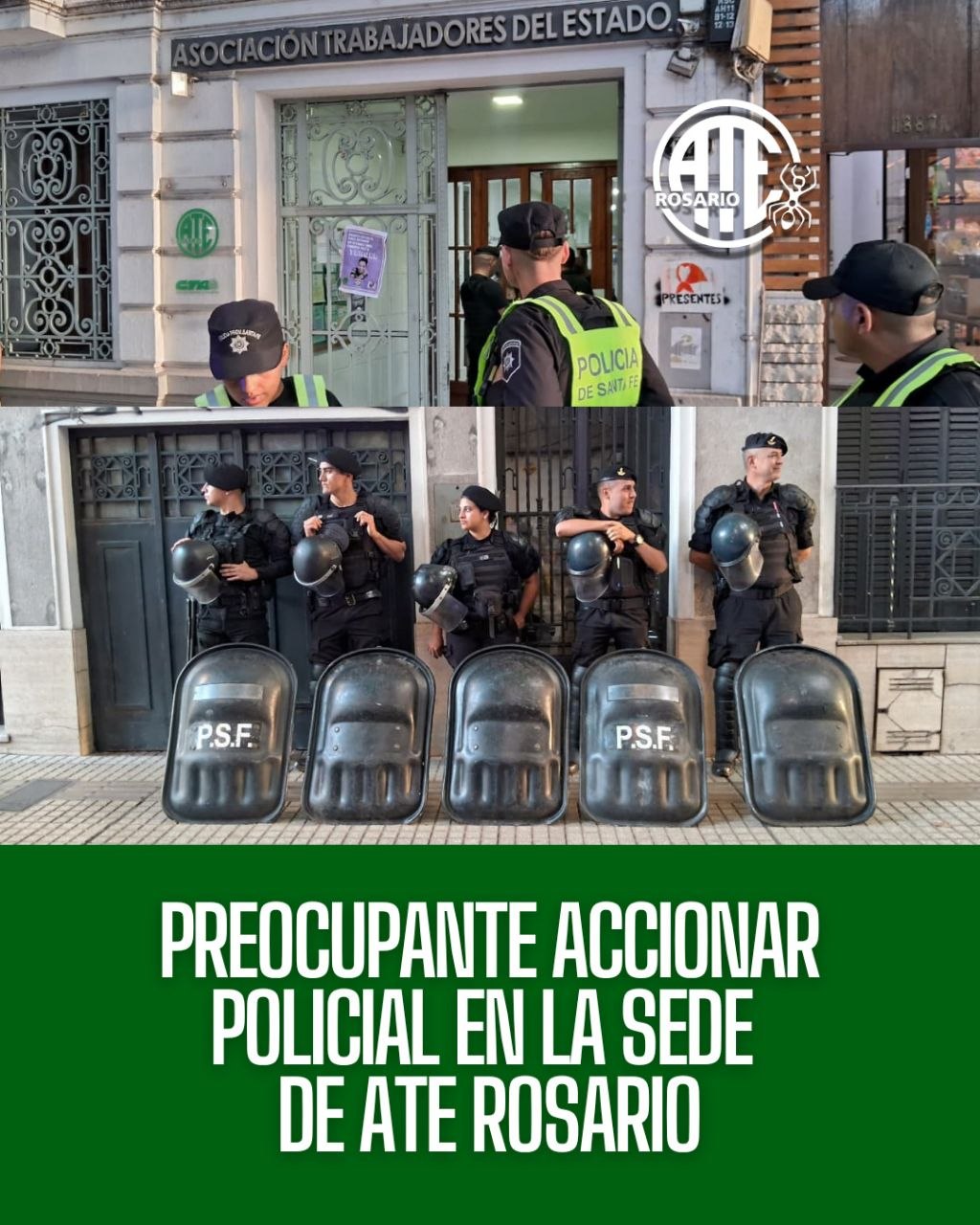
Once this activity was made public, the local Zionist movement, through DAIA (Delegation of Argentine Jewish Associations), launched a media and legal harassment campaign to stop the event and pressure the members of ATE Rosario who had offered the venue for the gathering. There was a swift and organized collective response, both from the Assembly and its member organizations, as well as from other social and political groups across the country who publicly came out in support of the event. This occurred within a context of censorship and repression carried out by the national government of Javier Milei, as well as by Maximiliano Pullaro in the province of Santa Fe, and the Zionist Pablo Javkin in the city of Rosario.
The repression was evident in the heavy police presence, led by riot police, who attempted to enter the ATE Rosario headquarters to film the event. Once again, the popular response was to halt this offensive, speak to the media to denounce the situation, and then proceed with the Assembly inside the state workers’ union headquarters.
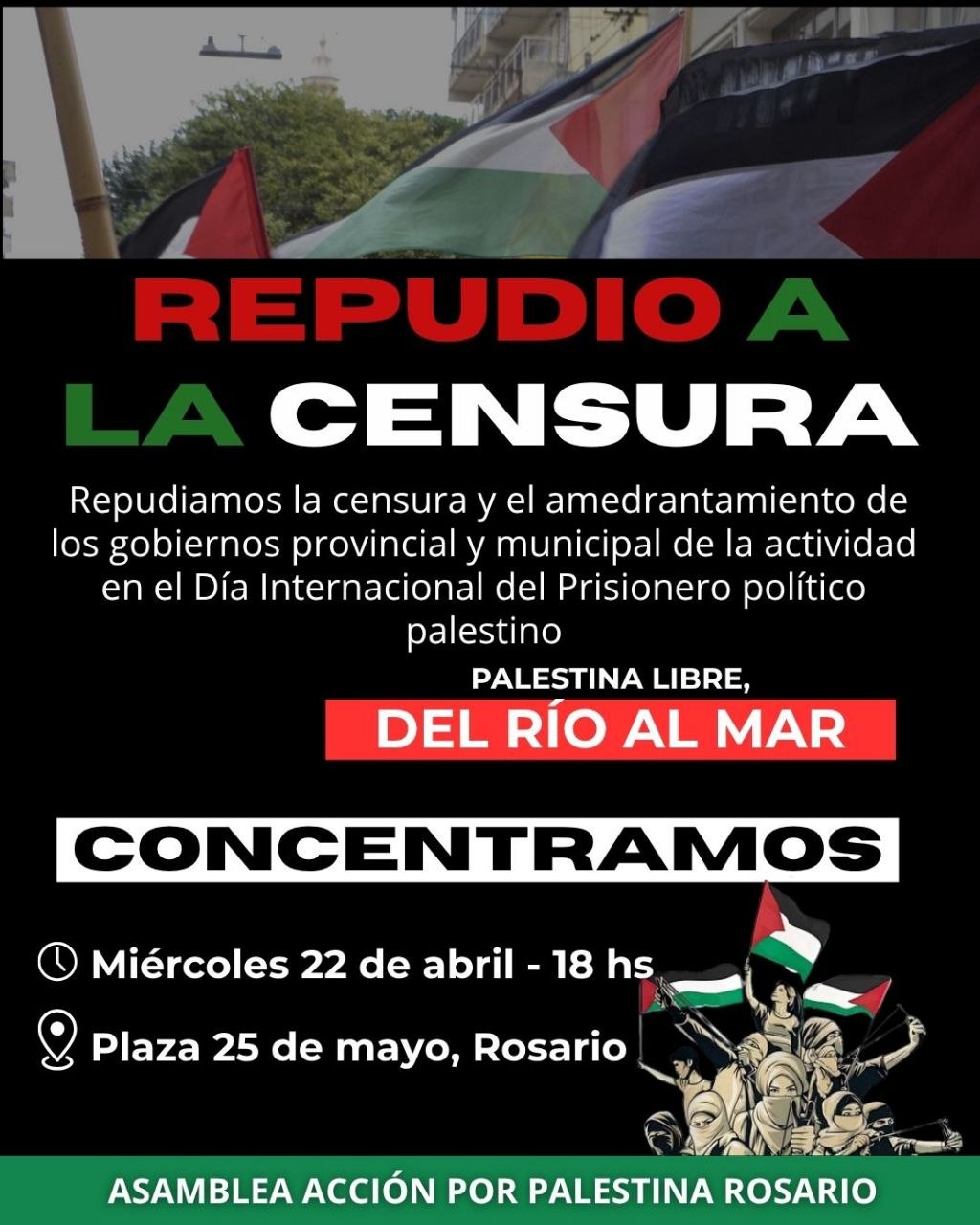
The massive presence of social, human rights, labor, and political organizations, as well as independent comrades, allowed us to debate, raise awareness of the situation, and reach a consensus to continue mobilizing and escalate our actions in future initiatives. The agreement reached by our comrades is to call for a rally in Plaza 25 de Mayo (Rosario, Argentina) next Wednesday, April 22nd, at 6:00 PM, under the slogan: “We condemn the censorship and intimidation by the provincial and municipal governments of the activities on Palestinian Prisoner’s Day. Free Palestine, from the river to the sea.”
We broke the censorship. The event took place.
“Reproduce this information, circulate it by any means available to you: by hand, by typewriter, by mimeograph. Send copies to your friends: nine out of ten will be waiting for them. Millions want to be informed. Terror thrives on isolation. Rediscover the moral satisfaction of an act of freedom. Defeat terror. Share this information.” Rodolfo Walsh (Argentine journalist and revolutionary activist assassinated in 1977 by the last civic-military-ecclesiastical dictatorship)
The discussion with the two liberated prisoners was held with simultaneous translation provided by the members of Masar Badil and hosted by journalist Lisandro Brusco.
The interview lasted almost an hour with former Palestinian prisoners Osman Bilal and Nader Sadaqa. Both were essential figures in the struggle of the Palestinian people, demonstrating resistance, perseverance, and dignity in the face of decades of imprisonment. They belong to a generation that has spent much of its life in the occupation’s prisons without ever renouncing its convictions.
Osman Bilal, a fighter with the Izz al-Din al-Qassam Brigades, originally from Nablus (West Bank/Palestine), was arrested in 1995 and sentenced to 27 life sentences, one of the harshest sentences ever imposed on Palestinian prisoners. During nearly 30 years of imprisonment, he has experienced the true nature of the occupation’s prison system: isolation, interrogations, deprivation of basic rights; but he has also been part of the prisoners’ internal organization, their daily resistance, and their ability to remain steadfast as a collective. Osman Bilal is not just a former prisoner; he is part of a generation that built the first structures of resistance in the West Bank in the 1990s, alongside other freedom fighters.
Nader Sadaqa, also from Nablus, was born in 1977 into a Samaritan family. He became involved in national political activism at a young age, from student activism in schools and university union work to joining the Popular Front for the Liberation of Palestine. He was arrested in 2004, after two years of persecution, accused of more than 34 charges by the Israeli colonial regime’s judicial system, and sentenced to six life sentences. He spent 20 years in prison, where he began a new phase of struggle, becoming a pillar of the Palestinian prisoners’ movement and the Popular Front’s prison wing, in addition to his active participation in political training programs within the prisons.
Their release came within the framework of the prisoner exchange agreement known as the Toufan al-Ahrar, the Flood of the Free, which was not merely an individual achievement but a collective victory, the result of resistance on all fronts. It is a reminder that the issue of prisoners remains central to the struggle for the liberation of Palestine.
In this case, we have the opportunity to hear directly the voices, experiences, and analyses of our comrades, something that has been silenced for decades behind the walls of Zionist prisons.