
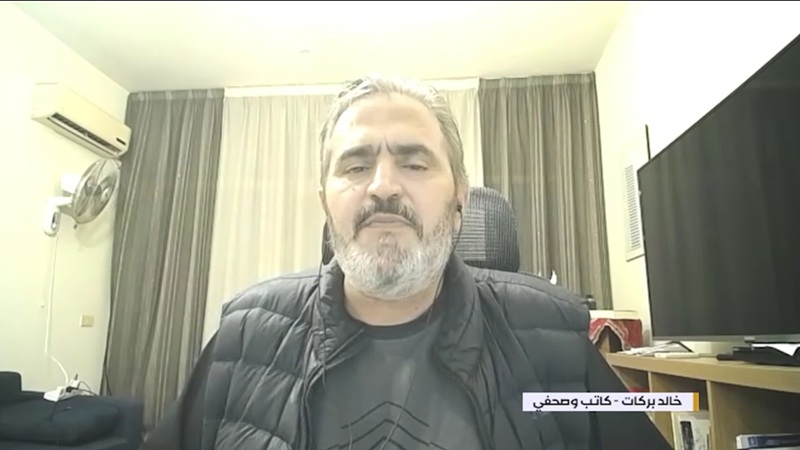
Arab writer Khaled Barakat, member of the Executive Committee of the Masar Badil, the Palestinian Alternative Revolutionary Path Movement, affirmed that the United States is experiencing a deep and complex crisis that extends beyond the economy to the structure of the political and social system, and even to the ruling class itself, in an interview on Sunday, January 11, 2026 with the Yemeni Al-Masirah TV channel. He pointed out that the escalating protests in American cities reflect an unprecedented state of internal tension and a sharp division within U.S. society, including within the very base that brought Donald Trump to the White House.
Barakat explained that the Trump administration is carrying out a widespread assault on civil rights within the United States, manifested in systematic policies of repression against migrants, refugees, Black people, and people of color, and in mass arrest campaigns targeting hundreds of thousands of people without genuine charges, solely because of their immigration status.
He noted that American police commit almost daily murders in more than one state against Black citizens and immigrants, without these crimes receiving media coverage commensurate with their gravity.
He pointed out that Trump is trying to market these repressive policies as “achievements” of his administration, while the reality reflects an unprecedented escalation in domestic violence, with American citizens killed daily by police agencies. This reveals the nature of the United States as the country that most frequently engages in organized killing, both within its borders and beyond.
Barakat linked this internal repression to aggressive U.S. imperialism globally, emphasizing that U.S. aggression against peoples and nations is a direct reflection of the structural crisis within the empire, not evidence of its strength.
He explained that the slogans raised in the demonstrations in the United States today are not limited to domestic issues, but also include rejection of the aggression against Venezuela, condemnation of the genocide in Gaza, and opposition to American imperialism and its policies in Latin America and the Arab region.
He explained that talk of “a thousand demonstrations” against Trump’s policies essentially means a thousand protests against the entire American project in the world. He emphasized that these popular movements reflect a growing awareness among Americans that Trump’s policies do not serve them, but rather the narrow interests of a very small class, no more than one percent of society, comprising bankers, major corporations, and oil and arms companies.
Barakat stressed that Trump’s claims about the recovery of the American economy and his economic achievements lack any credibility with the public. He pointed out that the average American citizen is experiencing a series of crises in living standards, health, and employment, while billionaires and owners of giant corporations are accumulating unprecedented wealth.
He affirmed that Trump no longer even tries to conceal the true objectives of his foreign policies. He openly declares that his interventions aim to serve American corporations, control Venezuelan oil, and impose American control on other countries, as he seeks to do in Gaza and elsewhere. This contrasts with previous administrations, which attempted to cloak their policies in false humanitarian narratives.
He argued that this blatant candor contributed to exposing the “America First” slogan, which is now popularly perceived as “Banks First” and “Oil Companies First.” This has led to a widening circle of popular rejection, extending beyond the anti-Trump camp to include his former supporters, who have begun to realize that his policies fundamentally contradict their interests.
Barakat also addressed the international stance on Trump’s policies, noting that the Zionist entity was the only party to openly support his aggression against Venezuela, while these policies faced widespread global condemnation. He emphasized that the crimes of the United States and its allies in Palestine, Yemen, and other regions have solidified America’s image as the “greatest source of evil” in the world.
Regarding the escalation against Iran, Barakat emphasized that the United States and Israel cannot engage in open warfare against the Islamic Republic without first securing its outcome. This is prevented by the balance of power maintained by Iran and its ability to defend itself and respond to any aggression. He asserted that Iran is not an easy arena for repeating past conflicts, as has been the case in other countries.
Barakat concluded his remarks by warning that the United States is entering a period of heightened internal tension. He predicted that waves of popular anger will escalate in the coming days and weeks, and that protests will transcend the traditional form of demonstrations. This is due to policies of mass arrests, family separation, and crimes targeting children and women. Furthermore, he noted the growing discussion within the American media, including political and comedy programs, about Trump’s personal conflicts of interest and his direct profiteering from the deals he makes. This will not go unpunished, he warned, and will exact a heavy political and social toll on his administration and the entire ruling class.
Source: Almasirah.net