
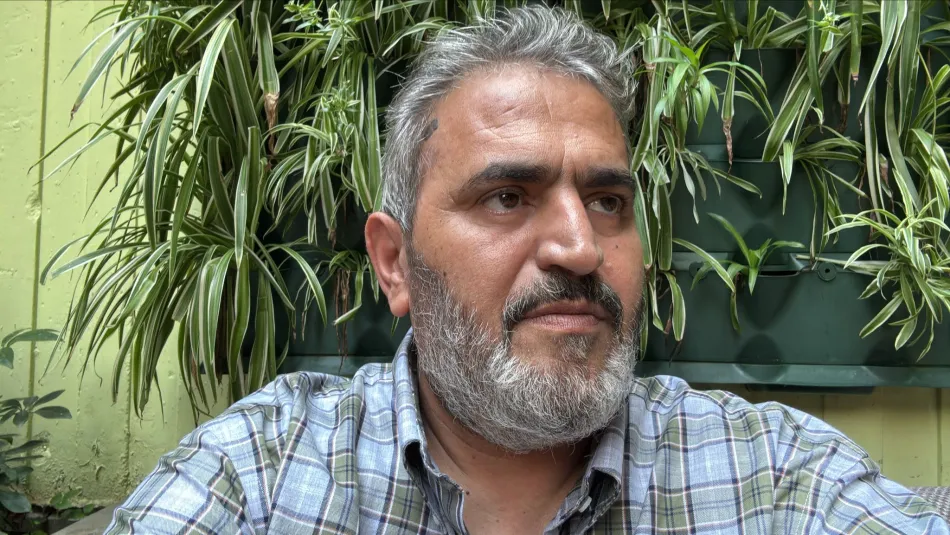
The following interview with Khaled Barakat, member of the Executive Committee of the Masar Badil, the Palestinian Alternative Revolutionary Path Movement, was published originally in Arabic in Al-Modon.
By Ahmad al-Hajj Ali
Sunday, 24 May 2026
The United States added leaders in the Palestinian Alternative Revolutionary Path Movement, Jaldia Abubakra and Mohammed Khatib, to its sanctions list. The movement, founded in 2021 on the initiative of a number of Palestinians and Arabs, including the Lebanese writer and publisher Samah Idriss and Khaled Barakat. Al-Modon met with the latter, as one of the most prominent members of the movement’s collective leadership, and asked him about the decision, the future of the movement, and its role in the diaspora in particular.
Barakat, born in Jerusalem, who himself was placed years ago on the U.S. sanctions list and later exiled from Germany, believes that the sanctions imposed by Washington on Masar Badil leadership members Jaldia Abubakra and Mohammed Khatib “fall within the framework of a continuous and failed Zionist attempt to halt the activities of the Masar Badil organizations and their active role in supporting the struggle of our people. The goal behind this unjust decision is to push us to adopt different language and positions through pressure, harassment and legal persecution, but this will not happen. The U.S.-Zionist enemy fails the moment we hold firmly to our path and our position and intensify our activity. This, at least, has been our experience in confronting repression and policies of criminalization.”
He added: “Washington has a list containing around 1,700 Palestinians, Arabs, Muslims and internationalists; only three of them are members of the executive body of the Palestinian Alternative Revolutionary Path Movement. Washington seeks to criminalize every meaningful activity, act and statement that stands with the Palestinian people, and to criminalize the struggles of peoples seeking liberation. The American government acts at once as police officer, lawyer, judge and executioner.”
He acknowledges that these decisions “have a direct negative impact on those they target. These are security decisions based on lies and outside the law, engineered to restrict the movement of militants and activists, targeting their role and livelihood in an attempt to isolate them and use them as a scarecrow. Since the Zionist occupation placed the Samidoun Network (which is part of the Masar Badil) on terrorism lists in 2021, then banned it in Germany in November 2023 and later added it to terrorism lists in Canada and the United States on 15 October 2024, despite all the Zionist and racist campaigns, Samidoun’s strength has multiplied, the presence of the Masar Badil has grown, and its membership and supporters inside and outside these countries have increased. Therefore, we say that the Zionist movement has failed in its efforts and continues trying to criminalize our organizations.”
He continued: “This reality, of course, does not mean relying solely on our own internal capacities. Such laws must be confronted through counter-campaigns, politically and legally, and through mobilization and organization to confront them. This issue does not target one organization or one individual in particular; it targets our people and attempts to distort their national goals.”
The Alternative Revolutionary Path
But why launch the Masar Badil, the Palestinian Alternative Revolutionary Path Movement, when there are around 20 Palestinian factions? Barakat answers: “We do not see ourselves as a Palestinian faction, and our people do not want more factions and names. We are an internationalist Palestinian popular movement, and we are not an alternative to anyone. We called for an alternative revolutionary path in confrontation with the path and approach of surrender in the Palestinian arena. As we explained in our founding documents and political positions, the name is linked to a comprehensive revolutionary path — political, economic and social — in confrontation with an officially defeated Palestinian approach whose project was embodied in the ‘Madrid–Oslo’ conference and the train of liquidation that began early with what was called the ‘phased solution’ or the ‘interim program’ in 1974.”
He added: “Our Palestinian people deserve an alternative revolutionary path to the current state of chaos, whose results we see daily in a powerless Palestinian Authority in Ramallah that deliberately obstructs every initiative for change and reform. The path we call for is an alternative to this Palestinian class that grips the spirit of our people’s cause. The alternative we aspire to will be created first and foremost by our people, by their national forces and their militant prisoners’ movement in the prisons of the enemy. At the heart of all this stands the will of our people in exile.”
He believes that “the Movement is a rear guard and support force for the resistance; indeed, it considers its role to be an internationalist rear guard for the resistance in Palestine and the region. We are an inseparable part of our people’s movement and struggle in exile against colonialism, Zionism, occupation and its supporters.”
He sees that “the Palestinian resistance forces, with all their political and ideological currents, can — if they possess the political will and vision — establish a unified Palestinian national front that breaks with the approach of the Authority, provided they abandon the illusion of reforming the Authority’s forces. Palestinian national unity cannot be achieved with a surrenderist approach that still declares its commitment to the path of concessions, compromise and monopolization of national decision-making.”
How Can the Diaspora Reclaim Its Role?
Regarding the movement’s origins, Barakat traces them to the end of October 2021: “After dialogues that lasted about a year among groups and personalities in the diaspora, predominantly youth, students and women. These dialogues took place directly through cultural and political seminars via video, and undeclared bilateral meetings, in an attempt to answer the persistent questions of the Palestinian reality: How can the diaspora reclaim its role and sources of strength? How can the unity of our people and our cause be achieved in the face of liquidation projects? What is the role of Palestinian youth and solidarity movements across North America, Europe, South America and elsewhere? Can the role of our people in exile be revived without the central participation of the Palestinian camps in Lebanon, Syria and Jordan? The Path emerged from the womb of all these questions and others.”
As for what the movement has managed to achieve, Barakat says: “If we assess our role over the five years of the movement’s life, 2021–2026, we believe its first achievement has been building bridges of dialogue and cooperation between the Palestinian and Lebanese resistance and others on one side, and dozens of liberation forces around the world on the other, while strengthening our relationship with revolutionary movements that support the resistance and stand with our people. The internationalist dimension of the Palestinian cause was destroyed after the Oslo Accords. We organized dozens of forums and joint meetings addressing this issue.”
He continued: “The movement presented a revolutionary model by adopting radical political positions inside the ‘belly of the imperialist beast,’ through raising the slogan ‘Palestine will be liberated from the river to the sea.’ At the time, we were part of a minority raising this slogan, then it became a defining slogan of the global popular movement after October 7. The movement succeeded in highlighting the centrality of our people in exile, especially the new generation, through organizing liberation and return marches and breaking Western taboos. The enemy’s embassies failed to prevent them, whether in Canada, Belgium, Spain or elsewhere.”
He added: “Today the movement includes women’s, student and youth organizations, and pioneering militant networks such as the Samidoun Prisoner Solidarity Network. Since the launch of the Alternative Revolutionary Path Movement, we have carried out more than 1,000 political and mass activities; some attended by tens of thousands, others by only dozens. What matters is that the movement carved its path relying on the self-capacities of its cadres, not on any state here or party there. We are not exaggerating when we say the movement has become a ‘problem’ for the Zionist movement by the enemy’s own admission. This explains the continuous targeting of the movement’s cadres and the attempts to criminalize it.”
A Political Movement Born in Exile
Regarding his movement’s focus on the Palestinian diaspora, Barakat says: “This is a political movement born in exile, and it considers one of its foremost priorities to be overcoming what the dominant Palestinian ‘leadership’ destroyed, especially the destruction of our people’s institutions in exile after the Oslo Accord and the establishment of the self-rule authority. This was accompanied by a policy of marginalization and exclusion of our people, especially in the camps and in the diaspora generally.”
He stresses that the primary task “is restoring this role to the diaspora for the sake of our people in the occupied land and our people in exile alike. The unity of our people is a red line for us, and all our organizations work in the service of the prisoners and in confronting the war of genocide against our people in Gaza, in addition to the modest efforts supervised by the movement in the field of alternative popular education and supporting national and cultural initiatives in the occupied land.”
He points out that “whoever observes the situation of our people in exile, in Lebanon for example, clearly sees the reality of our camps, how they were stripped of their national cause, how their popular decision-making and institutions were confiscated, and how they were driven into poverty, deprivation and illness. How can a besieged people liberate themselves and return to their homeland without organization and the ability to confront? And how can they break their chains while being subjected to dozens of discriminatory laws that deny them their basic rights? The struggle for liberation and return proceeds in parallel with our people achieving their civil, political and cultural rights; there is no contradiction between them. The more our people achieve rights in the camps, the closer they come to accomplishing liberation. Liberation begins with our people reclaiming their voice and demanding their right to participation and decision-making.”